Thursday, December 02, 2021

Neighborhood Places

"Grazie, cara."  "Carissima." "Ciao bella".  These are common salutations in Italy, phrases I hear routinely from strangers, shop owners and friends.  It is part of the Italian charm, what makes people feel welcome quickly.  Combine these with the joy of being in a favorite neighborhood spot, and you will think you are at home. 

On my second day in Florence (September, 2021), I wanted to get some lunch, so I went outside to see what I could discover.  From my apartment, I walked a few minutes to Piazza Tasso, but nothing intrigued me.  On to via del Campuccio, which has no restaurants, but connects to other streets with cafes.  On the corner of via dei Serragli there were tables outside, a few people and the sign of "Caffe Mi Piace" ("I like coffee") over the doorframe. It looked like a good choice. I poked my head in the door, said "Buongiorno", and surveyed the platters of vegetables, pastas, rice and meat that were on the top shelf.  Everything looked tasty and fresh. The owner asked if I wanted a "plate of the day."  Certo!  


The "piatto del giorno" is a mixed plate of what the chef has prepared for the day.  This cafe is owned by a husband and wife, and the wife does the cooking.  My first visit, and on each subsequent visit, I sat outside  within a small area equal to several parking places that was surrounded by plants. The portions are generous and the couple is proud of the food they prepare.   Grilled radicchio, broccoli, beans, rice.  Fresh bread. Sparkling water.  On my first visit, I spoke with a woman seated nearby.  The owner brought me a small pastry and when she said she wanted one too, he replied it was only for tourists.  They clearly knew one another and laughed.  

When I returned the following week, the owner smiled and said, "Ciao, bella." There it is- the sweet recognition and a way to say "Welcome back".  He turned to his wife and asked if she remembered me.  She scowled and said of course.  When I started to choose what I would have for lunch, she said to me that she would prepare the plate.  Ok.  I went to sit in the sun.  When I finished eating and went inside to pay, the husband of the couple asked for 8 euros instead of 8.50.  A small "thank you" for my return visit. 


When visitors think about aspects of Italy that they love, surely this scenario comes to mind-- a warm greeting, wonderful food, a reasonable price, the feeling of belonging.  Certainly, all over the developed world this exchange and opportunity exists.  A local coffee shop, wine store, or favorite pizzeria.  What makes the experience so special in Italy? 

Shortly after the second visit, I sprained my ankle and couldn't easily walk to Caffe Mi Piace.  But, when I again returned, I was greeted with "Ciao, amica" by the husband, Roberto, and a friendly smile from the wife.  (He is clearly the more gregarious of the two.)  I sat at my usual table in the sun and was served a generous meal of seasonal specialities.  Other people ate lunch outside, some with a mixed plate, others just had pasta.  Many people picked up food to go.  A few ordered a panini, or just a quick coffee.  Roberto seemed to know everyone.  

Tomorrow the weather will be warm and sunny, even though it's mid-November.  I'll go back to Caffe Mi Piace, sit at my usual table, and enjoy being a "regular" in the neighborhood.  Grazie, cara.  


Tuesday, October 12, 2021

Massa Marittima

On the third day of our weekend getaway in the Maremma, my friends opted to skip the beach and instead visit the town of Massa Marittima on our way back to Florence.  I had not been to this town, and truth be told, had not heard of it.  Sergio mentioned that I would get to see the famous fresco of a "cock tree".  I wasn't sure how to imagine this fresco, and Sergio just said to wait and see.  I was intrigued.  

Shortly after we left the B and B, we turned off onto a dirt road. "Where does this lead?" I asked?  The reply, "To the house up ahead."  Our first stop was at a farm to buy some of their favorite jarred veggies and sauces.  First we chatted.  Then, we selected vegetables that were picked that morning-- pomodorini, lettuce, zucchini blossoms, an assortment of peppers.  We crossed the lot from the farm area into the shop where there are cupboards of jarred vegetables.  A specialty of this shop is the artichokes.  After a comprehensive selection, payment and more conversation, we were on our way.  

Since we were still in the hills of Tuscany, the drive was beautiful.  We reached the municipal parking lot of Massa Marittima in time to get one of the last spots.  It was Sunday, good weather, and a mountain bike race ending in the town!  Our first stop was the fresco.  


Try to look closely and see the "unusual fruit" hanging from the tree and that the women are collecting.  The fresco is located behind a trough where women would go to wash clothes.  It was hidden behind a plaster wall and discovered in 1999!!  The fresco is dated between 1265 and 1335 and referred to as the "Tree of Fertility".  It might also have been symbolic for an abundant harvest.  

The area of the town dates back to prehistoric times.  There were Etruscan settlements nearby.  It was caught between the wars of Siena and Florence. In more recent history, Massa Marittima  was an important site for the mining of minerals such as iron, mercury and copper.  The last mines closed in 1994, and now its main income is tourism. And, apparently, mountain biking.  


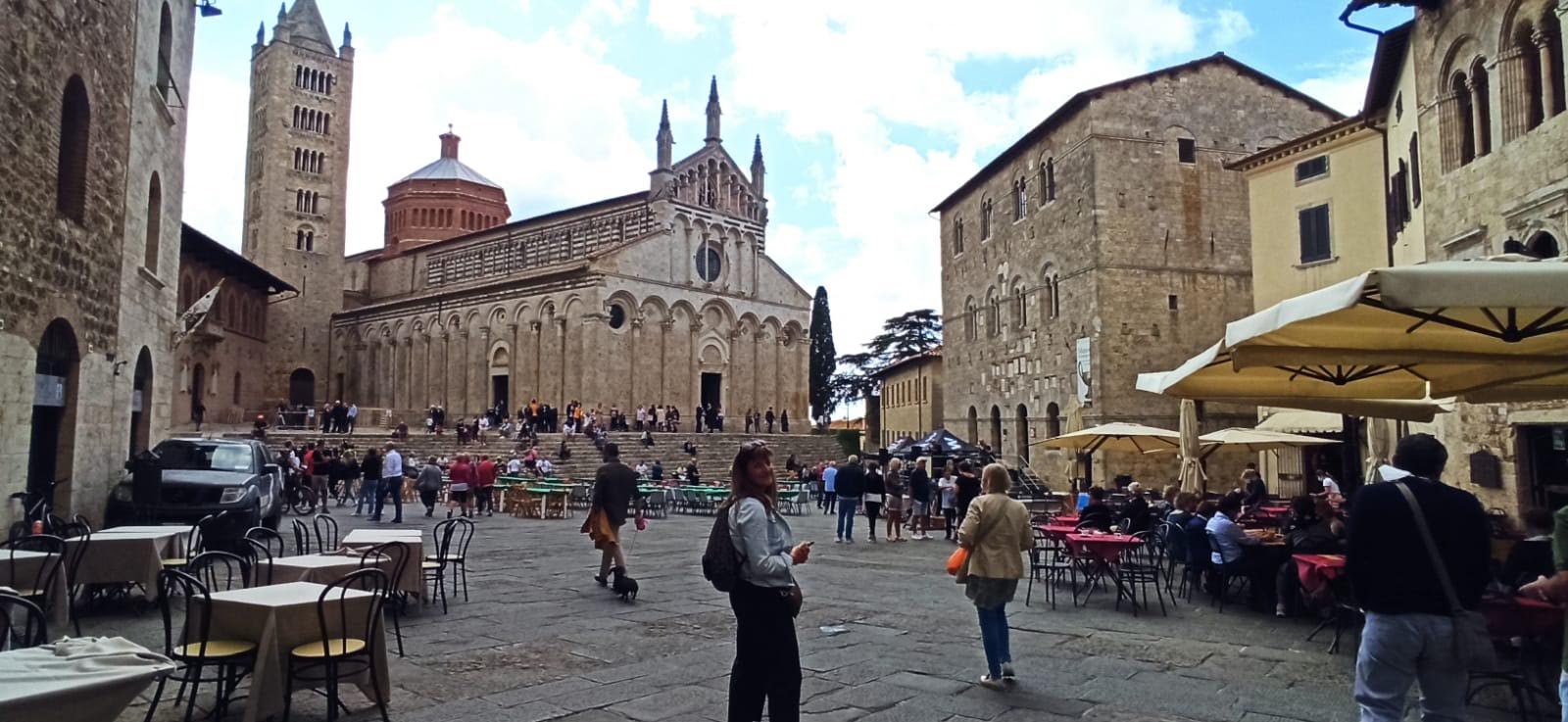
The construction on this cathedral dates to the 1200's.  It is dedicated to San Cerbone, Saint Cerbonius, who had a long and unusual life.  His story is told in bas relief around his tomb inside the church and also above the door on the outside of the cathedral.

https://en.wikipedia.org/wiki/Cerbonius

https://www.turismomassamarittima.it/en/la-cattedrale-di-san-cerbone/


The day we visited Massa Marittima, was also the day of a mountain bike race.  For me, this was quite special as it brought back memories of the many times I accompanied my son to various mountain bike races and courses, especially before he could drive.  In this piazza, the contrast of the young riders and the ancient buildings was notable.  


http://www.thetrailbrothers.com/en/

The day was wonderful and filled with the joy of being in Italy-- good friends, surprising art, ancient history, great food, and the sign of new life in old surroundings.


Be sure to add Massa Marittima to your travel list for Tuscany!  Ciao for now! 

Tuesday, October 05, 2021

The Maremma


Travel might take us to a new place, or to a favorite destination.   When my neighbors asked me to join them for a trip to the Maremma, of course I agreed.  The Maremma is one of my favorite places along the Tuscan coast. And, we would stay at an agriturismo (B and B) that feels like home-- with kind hosts, a friendly dog, a pool, and a spectacular view into the hills.


The Maremma is located on the western side of Tuscany. The drive from Florence is beautiful-- rolling hills, olive groves, corn fields and in the summer, acres of sunflowers.  Some of the land remains undeveloped, in part due to the wetlands and malaria that existed only decades ago.   There are hilltop villages and castles, towns along the coast, hotels and vacation rentals.  Unlike in Florida where I spent several weeks this summer, the land around the coast is not flat and there are no palm trees.

https://www.discovertuscany.com/maremma/

http://www.travelingintuscany.com/engels/maremma.htm

At the beaches in Italy, it is common to pay for services at a "bagno".  Each bagno has a name and provides what you need for the day-- lounge chairs and umbrella, a place to change, bathrooms, and a restaurant.  The colors of the umbrellas vary from one bagno to another, which creates the rainbow that you see in the pictures of Italian beach resorts. Since it was already the first of October, only a few of the bagnos were open.  We had a very nice spot with Bagno La Vela which we enjoyed for two days of sun and waves.

http://www.castiglionepescaia.it/en/5079-2/

On our first evening, we drove to Vetulonia for an aperitivo and sunset.  The origins of the town date back to Etruscan times- approximately 600 years BC.  In past years, my friends rented a flat in Vetulonia to use a base to go to the beach and explore the area. I had also been to Vetulonia with them before and understood its lure.  When we arrived to one of the few bars, they were greeted warmly. The bar with a view to the sunset is a popular gathering spot.  I asked my friend about the population and she reminded me that there are 254 inhabitants.  There was a mix of old and young having a spritz or beer.  I wondered what it would be like to live in such a small community, full of natural beauty and history, though none of the activities that I enjoy.  


Dinner both evenings were at a local restaurant near our B and B.  The restaurant was busy, with tables inside and outside.  There were German tourists at the table next to us.  The service was efficient, the wine and food very good.  The first night I had cream of pumpkin soup, salad, tagliatelle with cinghiale (wild boar sauce). The second night I had pizza.  Certo!  Speaking of wild boars, we did spot a white boar on the side of the road as we drove back in the dark to where we were staying.  The next night, I was awakened by clacking and digging sounds-- wild boar tearing up the yard to eat the roots of the grass. I did not get out of bed to investigate, and in the morning was a bit regretful that I had missed such a photo opportunity.  

The time at the beach, early morning swims, and good company were just the reset I needed after a frustrating week of trying to recover the items that were in my stolen wallet.  

The third day we bypassed the beach and instead went to a small farm and then the old city of Massa Marittima.  That will be a separate post. 

Thursday, January 21, 2021

What is possible?

I drafted this post more than a month ago, when I was still in Florence.  The idea of "possibilities", though, is relevant in many circumstances. Often, I have to remind myself that I have a choice, that there is more than one possibility. I recall that on my first trip to Italy, a hotel manager in Rome explained this--"Americans think that there is only one possibility, for instance 2+2=4.  But, Italians understand that there is more than one possibility, that 3+1 also equals 4."  Here is how I came to more fully comprehend and admire how some Italians interpret a rule.

In the late autumn, when the restrictions in Florence increased to "zona rossa" or "red zone", most shops closed and the movement of residents was curtailed. Some of the restrictions were vague, which made me nervous.  What exactly was meant that a person could exercise on foot or bicycle, but "near one's home"?  Could I go for a jog in the park or not?  What was I supposed to write on the required "declaration" form?  Would my reason for being out be accepted if I were stopped by the polizia? 

The first day of the restrictions, I decided to stay in except to get groceries a block away.  I discussed the situation with my neighbors. Ursula printed out copies of the required "declaration" form, and Sergio explained how to fill in the information.  They each reassured me that I could go for a jog and take walks.  Sergio elaborated, "Basically, no one cares." 

The obvious choices of shops to be open were the food stores, pharmacies, banks, post offices, shipping agents, newspaper stands.  Additionally, stores selling children's clothes could be open, which applied to The Disney Store, even though its clothing section was limited. Also open were shops selling intimate apparel (underwear, socks, pajamas) and self-care items. Sephora (make-up and more) was open, as was Jo Malone (expensive fragrances and candles).   So, one afternoon I took a walk to Sephora.  I was beginning to understand. 


Included in the food stores were also shops selling gelato and chocolate. Close to Sephora and the breathtaking Duomo is Venchi, with its dramatic wall of flowing chocolate.   I stopped to get candy for Christmas gifts, and also a gelato. Perche' no?  Why not?   I asked for a cone.  The saleswoman replied that she could not put my gelato in a cone, but she could give me a cone.  Here's how it worked-- my two scoops of gelato (two different flavors) were placed in a cup and another cup was placed on top.  This went into a bag... followed by a small spoon in its own bag, a cone in its own cellophane bag, and a paper napkin. I paid, found a place to sit outside, removed my mask, and disassembled the bags.  Instead of having the gelato piled on the cone, I used the cone as a scoop.  I have to confess that my first reaction was to be pleased about the creativity of the shop to insure that each customer would still get a cone.  My second reaction though, was concern about the additional garbage and cost of the bags within the bags.     

Each day, I figured out somewhere to walk, and filled in something vague on the required form. (I was never stopped.) A particularly fortuitous incident occurred on a walk on via Santo Spirito.  I passed an art shop where I had previously purchased a print, that was still in a poster tube at my apartment. I noticed the lights were on and the owners were inside.  I knocked and the son unlocked the door to let me in.  I commented that I was glad they were allowed to be open.  The son hesitated and said, "Well, we are here, and if someone walks by and wants to come in to the store, then we let them."  "Ho capito," I replied.  I purchased two more prints, and the owners mailed my previous purchase and the new prints to the US for me.  

There were numerous other times that we all found ways to live within the rules in a creative way-- getting a coffee or Prosecco in a shop and drinking in the open-air piazza, finding a place to hike that was technically inside of the city limits of Florence when we weren't allowed to leave town.  Quindi, therefore, the hotel manager from my first trip was correct, Italians know there is more than one way.  


Sunday, November 08, 2020

Seasons

A few days ago, November 6, I joined my neighbor to help with her friend's olive harvest.  Last November I went to pick olives for the first time at the same place. So much of my life in New Jersey was marked by the seasons, and it felt special to have that same experience in a different country. However, one year ago, the day had a different feel. For me personally, it was the start of my stay in Italy, with every day full of promise. Globally, there was no pandemic and no tension about waiting for the choice of the new US president.         


A day in the countryside to pick olives provided a break from constantly checking my phone to see the latest numbers for the Covid cases and the election results.  Being outside and "distanced" from  other people meant an entire day without needing a mask!  I felt productive and happy to contribute to such a worthwhile project as making olive oil. 

The Trump presidency and the election were often topics of conversation among American ex-pats, but also with my Italian friends and even with strangers.  Last week, while at the laundromat drying my sheets, a gentleman came in and inquired about the change machine and whether soap was needed in the washer.  (All the instructions are written in Italian and English.  He spoke Italian.) He asked me where I was from and when I replied "the United States" he gave a thumbs up and said, "Biden".  

Then, while olive picking, one of the women asked me why the election was taking so long.  She spoke a bit of English, and my Italian skills were not enough to explain the process of the absentee ballots and mail-in votes.  But, we did our best and she seemed to understand the many complications.  I'll tell you, when an Italian shakes her head over American bureaucracy, you know you are in trouble!!


Now, the election has been decided.  Hopefully, my sleep will improve! And, for America and the rest of the world, I have much bigger hopes.  


Tuesday, October 20, 2020

Layers

If you are a regular reader of The New York Times, you might recall this article from April, 2015, about a family in Lecce, Italy, who discovered remnants from ancient civilizations under the floor of their building.  The story is that Mr. Faggiano was digging to find a sewer pipe when he found underground rooms, tombs, and relics.  On my trip to Lecce, I visited what is now the Faggiano Museum and had an informative talk with Andrea Faggiano, who is running the museum. 


The Faggiano Museum is on a quiet side street in the historical center of Lecce.  While there is a small sign at the corner pointing to the museum entrance, it wasn't until I saw the blow-up of the front page of the New York Times article that I connected the family name to the story.   Fortunately, I had plenty of time to stop for a visit. 

As I was paying the entrance fee, I mentioned to the gentleman behind the desk that I remembered reading the article that was in the NY Times.  He was excited to hear that and introduced himself as Andrea, one of the sons mentioned in the article.  Andrea was living in London, in part to escape from the digging, but returned to help run the museum. He filled in other details of the story.  The journalist who wrote the article was in Lecce to write about a tree blight.  He knew of the "digging" and visited.  His wife encouraged him to write about the Faggiano family, which he did.  Andrea said the journalist figured the article would appear in the travel section of the newspaper.  Instead, it was on the front page of the New York edition, the International edition, and the Asian edition! Maybe April 14, 2015 was a slow news day? Needless to say, the museum got busy quickly, and now the fees help to support the family.  

Andrea provided an overview of the museum layout, gave me a document in English that explained each of the numbered items in the museum, and told me I was free to take photographs.  So, I set out to explore. 


The museum provides a glimpse into different civilizations, each built on top of the other.  While many items are on display, others have been taken into state custody.  Because of their discoveries, the Faggiano family has achieved some celebrity status.  They were honored in New York City by members of the Italian-American Museum.  In turn, when visitors with the Italian-American Museum decided to visit Lecce, they were given a warm welcome and a party at the Faggiano Museum.  

I asked Andrea if his father was still digging, and if he ever opened his trattoria.  The answer to both questions was "Yes!"  Mr. Faggiano purchased the building next door to continue his excavations.  And, a block away he was able to open his own cafe.  

Here's the link to the article.

https://www.nytimes.com/2015/04/15/world/europe/centuries-of-italian-history-are-unearthed-in-quest-to-fix-toilet.html

Wednesday, October 14, 2020

Go for Baroque

After my stay in Bari, I decided to go further south to reach Lecce.  If you look at a map of Italy, you will see that Lecce is located in the heel of the boot, almost as far south as you can go. Often, Lecce is referred to as the "Florence of the South", though other than artisan shops and open piazzas, I didn't see other similarities.  Lecce is unique. 

Lecce is over 2,000 years old, with a long connection to Greek culture.  (However, I did not observe modern ties to Greek foods or traditions.) The Baroque monuments were added in the 1600's and it is a significant feature that is distinctive to Lecce.  

Pictured here are the Lecce Duomo (cathedral), the Basilica di Santa Croce,  interior of Santa Croce, the Roman amphitheater (2nd Century AD), a public garden and park (Giardini Pubblici Giuseppe Garibaldi), and my post-breakfast snack of cappuccino and pasticciotto Leccese.  


The pasticciotto is a rich pastry filled with egg custard.  I ate the entire pastry one morning as a "snack". The following day on the way back to Florence, I lamented that I didn't buy one to eat on the train.  Each region has its own food, and these pastries are particular to Lecce.  

I liked everything about Lecce. The city is both elegant and lively. The shops are a mix of artisans, upscale, and funk. (I purchased a beautiful linen robe and table napkins at Society Limonta, which also has online shopping.) There is a wide range of restaurants from traditional cuisine, to pizza, to salads. There are plenty of places to enjoy a glass of primitivo and to buy taralli. I would happily return, but it's a long trek by train. (NB- It is possible to fly from Florence to Bari, though I prefer the train.)

Check out the link below for the restaurant Alle due Corti to learn about the local pasta dish called "Ciceri e tria". I ate at the restaurant and greatly enjoyed this traditional fare.  

http://alleduecorti.com/reloaded/index.php/2019/07/17/italian-traditional-recipe-ciceri-e-tria/?lang=en

Sunday, October 11, 2020

Progress

From the city of Bari, it is easy to visit both Matera and Alberobello.  I like having a guide at historical sites, so I searched online and got lucky with a wonderful guide through "Tours by Locals". Giorgio met me at my hotel and we proceeded first to Matera, which is about an hour away.  En route, I learned about the history of Bari, which includes complicated Mafia connections.  The south of Italy does not have the wealth and prestige as the north, and life was/is run a bit differently!  

Matera is a UNESCO World Heritage Site, one of the many in Italy. It is in the region of Basilicata, next to Puglia. You may recall that in 2019, Matera was named the European Cultural Capital.  And years before that, it was the setting of Mel Gibson's movie, "The Passion of Christ". Matera is an area of "Sassi" or cave dwellings.  The oldest dwellings are eight thousand years old, opposite the more "modern" dwellings.  They are divided by a ravine, which was once a river.   


The Sassi of Matera are regarded as "one of the oldest continuously inhabited cities in the world." The area was occupied by many different groups.  By the 1800's, Matera had extreme poverty, poor sanitation and disease.  In the 1950's, it was called "the shame of Italy" and the townspeople were forced to evacuate to modern housing in the "new" Matera.  For years, the dwellings were abandoned until the 1980's when the town became a historical tourist attraction.  Now, there are hotels, restaurants, shops and artist studios. 

There are several empty caves that are open to visitors.  One has been reconstructed to show what life might have looked like when the caves were inhabited.  There was a small kitchen and table.  Animals were housed inside the cave to provide heat.  The matrimonial bed has the toilet nearby and a loft above for children.  We can imagine that there was no privacy at all!! 


After lunch in the modern section of Matera, we got back on the road to reach Alberobello.  The guide pointed out the change in the landscape when we crossed from Basilicata into Puglia.  The olive groves returned in abundance.  

Alberobello is the home of the famous "trulli" and is also a UNESCO World Heritage Site.  We arrived first into the inhabited area of Alberobello. My guide, Giorgio, stopped to say hello to a family living in a trullo. The wife of the couple showed me her garden. Outside her door she had a table with fresh figs, at no charge, and I helped myself.  Mamma mia- delicioso! 

There were trulli that were open to walk through and imagine life in the round home with the conical roof. My guide explained that the original design of the roof was a way to avoid taxes.  The workers for the feudal lord Count Acquaviva lived in Alberobello, but he didn't want it to be considered a "town". So,  the stones on the roof were not joined with mortar, and when the keystone was removed, the roof would collapse. Thus, the building was no longer considered a house and so the area was not officially a town.  This was changed in 1797, and now each roof is permanent.  


A long post for a long and wonderful day!  I am always glad to see respect given to old ways of life. People live with what they know and what they are given, until something happens to improve their lives.  Even then, someone might like some of the old ways best of all. 


Tuesday, October 06, 2020

Heading South

With rain in the forecast and no activities in Florence, I decided to chase the sun and head south, all the way to the "heel of the boot" in fact.  My first stop was in Bari to see the "old town" and from there visit the villages of Matera and Alberobello.  Then, I planned to continue further south to Lecce. 

In order to reach Bari by train, I first went north to Bologna, and then along the coast to Bari.  The train ride is picturesque, with views of the hills and then the coast for many miles.  Since the trains are still running at 50% capacity, travel feels safe and relaxing.  


While the narrow streets of the "old town" do have souvenir stands, there is also a sense of real life-- small coffee shops, butchers, fruit and vegetable stands, non-touristy panino spots.  One church was setting up for a wedding. There were elderly out doing the shopping and stopping to talk.  There was an odd calmness between all the twisting streets.  


In the evening, the old town filled with youngsters on scooters, teenagers, adults and families.  It was exciting!  I had an aperitivo while looking at the sea, then walked to Piazza Mercantile (around the corner!) and enjoyed outdoor dining at a wonderful restaurant.  I was overjoyed at the sight of the bread basket alone!


In the picture, the restaurant tables are under the large umbrellas.  To the right, was a woman selling squares of freshly fried polenta.  (On my tour the next day, the guide said that she is there every day.) 


The region of Puglia is well known for seafood, burrata, focaccia, and taralli.  There would be plenty of all of that in the days ahead!  

Permesso Update

In previous posts, I explained the lengthy process to apply for a visa and then obtain a "permesso di soggiorno", or permission to stay, in Italy.  Here's an update.

My original appointment of March 17 was cancelled due to the lockdown in Italy and subsequently changed three more times.  This change required two additional health insurance policies- short term from July 30 to September 17, then long term for one additional year, ending July 31, 2021.

On September 17, my scheduled time to arrive at the questura was 10:40.  The person who is working with me went early and arrived at 6:40am and got on line.  At 7:30 she called me to ask if I could arrive by 8:00 instead of our agreed 8:30, because the police officer said there were many people working and the line was moving quickly.  This was good news! 

Shortly after I arrived, my number was called.  I had a folder of documents about my apartment, financial resources and health insurance.  I had all the back-up material from my application in New York City.  The only papers that were requested were for my private health insurance, and my four passport photos. (We had filed other papers upon my arrival in Florence.) By 9:00am, the first step was finished.

The next task was to get fingerprinted.  I was assured that this happened only one time, and then I would not need to be fingerprinted again in all of Europe.  Since the first task went quickly, we assumed the second part would go quickly as well, especially since I had a low number and would be in the second group to be called.  However, the wait was nearly three hours.  Bathrooms were locked.  There were a few places to sit down.  The windows were open, but there were no fans and certainly no air conditioning.  This is an immigration center and police headquarters in a large, cement block of a building. Since the Covid situation, people were required to line up outside instead of inside, which helped.

The fingerprinting itself took less than two minutes.  

After that, we said our goodbyes.  I went to have lunch and Ulrike went home to rest since she had to return with a client in the afternoon.  Maybe in a month, most likely two months, I'll return to get my residence card.  Hopefully, it won't already be expired, which happens in some cases.  


I walked a bit before deciding to have lunch at the well-known Trattoria Sergio Gozzi, in the San Lorenzo neighborhood, near the Central Market, since 1915.  They are famous for their bistecca, but I couldn't resist ravioli. 


Friday, October 02, 2020

Happy Memories

Readers of my blog have asked me to include some photos of myself!  Well, this isn't all that easy since I am often exploring on my own.  However, my neighbor and friend, Ursula, emailed me photos of our trip together that coincided with my birthday and Sergio's birthday.  You can see that we are alive and well! Amidst the chaos, frustration and sadness, I have also been blessed with happy memories.  


Pre-lunch aperitivo enjoyed in Calcata, (in Viterbo) Italy.


Sergio and I are strolling around.


Outside the Basilica di Sant' Elia.


Our trio at Villa Farnese, Caprarola, 1500's 


Note- I also tried to include other photos that I took, especially of the interiors, but the formats were not compatible and the alignment was incorrect.  Sorry! 

Thursday, September 10, 2020

Happy Anniversary

One year ago today I woke up for the first time in my apartment in Florence.  When I walked out of the door, through my neighborhood and reached the Arno River, I was amazed that I was here; some days, I still feel that way. To mark this anniversary, I decided to complete early morning "grocery shopping" in a few of my favorite spots, instead of going to the nearby supermarket.

My first stop was two blocks away at the fruit and vegetable vendor who sets up his food everyday at the side of the ancient door of San Frediano.  I bought peaches, apples, tomatoes, lettuce, onions, one red and one yellow pepper. The vendor gave me a stem of grapes, saying "Buon Appetito". And, before I paid, he asked if I needed basil or parsley.  The herbs are always gratis.  On my return, I stopped for fresh mozzarella, prosciutto, a multi-grain roll and schiacciata (similar to foccacia). I limit my consumption of prosciutto, but today is a special occasion!

Fruit, wine, bread, pizza

After putting away the perishables, I walked to Carduccio to get a cappuccino.  I sat and read a few articles about the wildfires in California. Then, to Enoteca Millesimi for a bottle of wine to share with friends. I included a few minutes of quiet in the church at Piazza Santo Spirito. My final stop was at S.forno Panificio to see the specials of the day.  I selected a slice of fig cake and small piece of pizza, even though I had already purchased food for lunch.  The pace of daily life can be very enjoyable!   

Cappella Frescobaldi, inside the church at Santo Spirito


How am I feeling about this year abroad?  This question has a complicated answer.  The start of the year held great promise, and many of my plans were realized.  I traveled in Italy, joined organizations, made new friends. I shopped locally and visited every museum. My kids came to visit for the holidays and we were all in Barcelona together to bring in the new year. By mid- January, I felt homesick, and made a plan to return to the US to visit friends and family.  I was excited!  Friends were coming to visit in the spring. All was well! Then, we received news of my mother's illness and the start of the pandemic.  Needless to say, everything changed.  

I left Italy on Friday, 13 March and returned on Friday, 29 May.  My time back home was not what I hoped. Kindness from friends helped me to deal with my mother's illness. She did not live long after my arrival; though through a grand grace, I was with her when she died. I stayed on in Florida for several weeks, then booked flights to visit my children. Eventually, I returned to Florence. My neighbors and apartment owners helped to ease my quarantine, and after two weeks, I set out to re-explore the city and reconnect with a few people.  On the one hand, much was the same, and on the other hand life felt very different. What are my goals now? Since then, my days have been up and down. I took a few trips which I enjoyed.  Travel with my neighbors is always wonderful.  In between, days can be lonely. Visitors from the United States are still not allowed in Italy.  When will this improve... chissa'... who knows? My appointment for "permission to stay" was changed four times and is now on 17 September.  A residence card will allow me to stay in Florence for another year. This second year in Italy, unlike the first year, is filled with questions and no answers.  


Laundry Day